How to Verify a Crypto Project Website and Avoid Phishing
A polished logo or a high search ranking does not prove a site is official. Cross-check the full domain through verified project channels before connecting a wallet or entering any information.
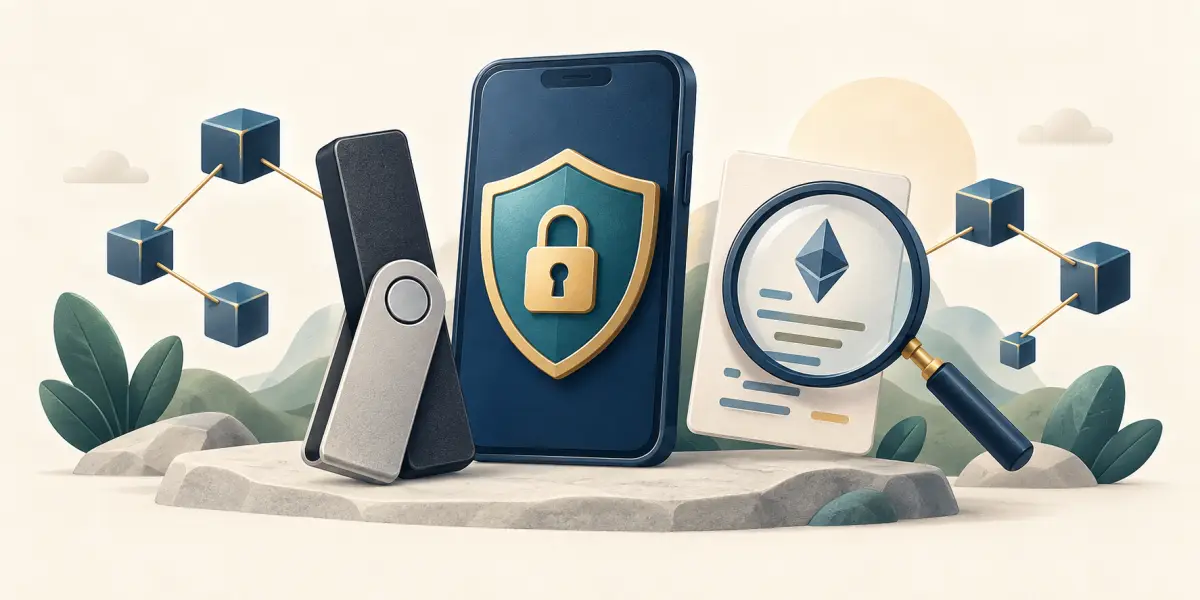
A visual reminder to verify before every sensitive wallet action.
Direct answer
A polished logo or a high search ranking does not prove a site is official. Cross-check the full domain through verified project channels before connecting a wallet or entering any information.
A practical safety guide for people who use a wallet, an exchange deposit page, or a blockchain explorer. The aim is to make the next decision safer—not to promise a financial outcome.
Step-by-step checklist
Start from a project’s verified social account, documentation, or app-store listing—not a direct message or ad.
Check the full domain, subdomain and spelling character by character; look-alike letters and extra hyphens are warning signs.
Read every wallet request; close any page asking for a seed phrase, private key or one-time code.
Keep the suspicious URL and screenshots, then report it through official channels.
Why this check matters
Before every sensitive action, verify the domain, the network, the address and the exact request. A minute spent checking is cheaper than an irreversible on-chain mistake. Keep a clean record of hashes and screenshots, but redact account secrets.
Blockchain activity is often irreversible once confirmed. Treat unknown requests, unusual downloads, direct-message support and guaranteed-outcome language as reasons to pause and verify independently.
Frequently asked questions
Should I act immediately?
Start by stopping the risky action and preserving accurate records. Do not let urgency force a transfer, signature or disclosure.
Can a transfer always be recovered?
No. Outcomes depend on the network and the party controlling the destination. Use only official recovery channels.
What should never be shared?
Never share a seed phrase, private key, password, one-time code, or remote access to your device.